Multi-Occupancy Fire Alarm Systems –
Multi-occupancy commercial buildings present some of the most complex fire safety challenges for property owners and facilities managers. Across Shipley, many office buildings, mixed-use developments and shared commercial premises rely on robust fire alarm systems to protect multiple businesses, staff, visitors and communal areas simultaneously.
Unlike single-occupancy buildings, shared premises require carefully coordinated fire safety strategies that account for varying occupancy levels, different business activities and interconnected escape routes.
A reliable commercial fire alarm system forms the foundation of that protection.
Many multi-occupancy buildings in Shipley combine offices, retail units, storage areas and communal facilities within the same property. Each tenant may operate different hours, use different equipment and introduce different levels of fire risk. A fire alarm system therefore needs to provide effective coverage across the entire building while supporting safe evacuation for all occupants.
In these environments, clear zoning and accurate alarm identification become especially important.
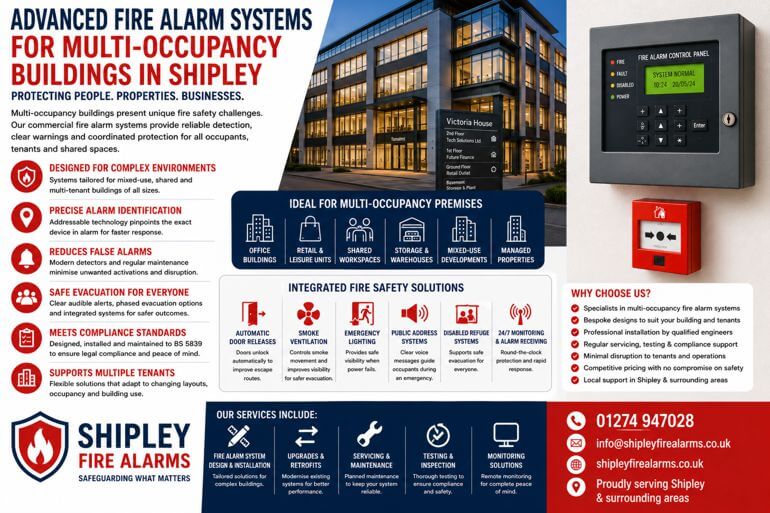
Addressable fire alarm systems are often the preferred solution for multi-occupancy buildings because they identify the exact device or location in alarm. Rather than identifying only a general floor or area, addressable systems provide precise information that helps emergency responders and facilities teams react quickly and efficiently.
For larger buildings with multiple tenants, this level of detail can significantly improve incident management and evacuation procedures.
False alarms are one of the biggest operational concerns within shared commercial premises. Repeated evacuations can disrupt multiple businesses simultaneously, affect productivity and create frustration among occupants. In some cases, frequent false alarms can even lead to complacency, reducing the urgency with which alarms are treated.
Modern detector technology combined with routine maintenance helps minimise these issues by improving detection accuracy and identifying faults early.
Multi-occupancy buildings also frequently contain shared escape routes, stairwells, reception areas and plant rooms. Fire alarm systems must integrate effectively with these communal spaces to ensure all occupants receive clear and consistent warning during an emergency.
In many buildings, fire alarms are also linked with automatic door releases, smoke ventilation systems and emergency lighting to support safer evacuation procedures.
Another important consideration is phased evacuation. In larger commercial properties, it may not always be appropriate or necessary to evacuate the entire building immediately. Modern commercial fire alarm systems can be configured to support staged or phased evacuation strategies depending on the building layout and fire risk assessment.
This helps reduce disruption while still maintaining effective life safety protection.
Buildings containing multiple tenants also require careful coordination around testing and maintenance schedules. Routine weekly testing and planned servicing need to be managed in a way that minimises disruption while ensuring systems remain compliant with BS 5839 recommendations.
Detailed records of inspections, faults and maintenance are particularly important in shared premises because multiple organisations may rely on the same fire safety infrastructure.
Monitored fire alarm systems are becoming increasingly common within multi-occupancy buildings across Shipley. Out-of-hours protection is especially important where buildings may be partially occupied or empty overnight. Monitoring services ensure alarm activations are immediately reported so that appropriate action can be taken quickly.
This added layer of protection helps reduce the risk of fires developing unnoticed outside normal operating hours.
Older shared commercial buildings can present additional challenges. Many premises have been adapted over time as tenants changed or building layouts evolved. Walls may have been added, offices subdivided and escape routes altered. In these situations, older fire alarm systems may no longer provide suitable detector coverage or evacuation support.
Professional system reviews and upgrades help ensure protection remains appropriate for the building’s current use.
Commercial insurers increasingly expect multi-occupancy premises to maintain professionally designed and regularly serviced fire alarm systems. Reliable fire detection not only supports legal compliance but also helps reduce operational risk and potential liability for building owners and management companies.
Businesses searching for Fire Alarms Shipley services are often looking for long-term reliability, proactive maintenance and scalable solutions capable of adapting to changing tenancy arrangements and building use.
A professionally designed commercial fire alarm system helps improve occupant safety, reduce disruption and support smoother management of shared commercial properties.
Multi-occupancy commercial buildings present some of the most complex fire safety challenges for property owners and facilities managers. Across Shipley, many office buildings, mixed-use developments and shared commercial premises rely on robust fire alarm systems to protect multiple businesses, staff, visitors and communal areas simultaneously.
Unlike single-occupancy buildings, shared premises require carefully coordinated fire safety strategies that account for varying occupancy levels, different business activities and interconnected escape routes.
A reliable commercial fire alarm system forms the foundation of that protection.
Many multi-occupancy buildings in Shipley combine offices, retail units, storage areas and communal facilities within the same property. Each tenant may operate different hours, use different equipment and introduce different levels of fire risk. A fire alarm system therefore needs to provide effective coverage across the entire building while supporting safe evacuation for all occupants.
In these environments, clear zoning and accurate alarm identification become especially important.
Addressable fire alarm systems are often the preferred solution for multi-occupancy buildings because they identify the exact device or location in alarm. Rather than identifying only a general floor or area, addressable systems provide precise information that helps emergency responders and facilities teams react quickly and efficiently.
For larger buildings with multiple tenants, this level of detail can significantly improve incident management and evacuation procedures.
False alarms are one of the biggest operational concerns within shared commercial premises. Repeated evacuations can disrupt multiple businesses simultaneously, affect productivity and create frustration among occupants. In some cases, frequent false alarms can even lead to complacency, reducing the urgency with which alarms are treated.
Modern detector technology combined with routine maintenance helps minimise these issues by improving detection accuracy and identifying faults early.
Multi-occupancy buildings also frequently contain shared escape routes, stairwells, reception areas and plant rooms. Fire alarm systems must integrate effectively with these communal spaces to ensure all occupants receive clear and consistent warning during an emergency.
In many buildings, fire alarms are also linked with automatic door releases, smoke ventilation systems and emergency lighting to support safer evacuation procedures.
Another important consideration is phased evacuation. In larger commercial properties, it may not always be appropriate or necessary to evacuate the entire building immediately. Modern commercial fire alarm systems can be configured to support staged or phased evacuation strategies depending on the building layout and fire risk assessment.
This helps reduce disruption while still maintaining effective life safety protection.
Buildings containing multiple tenants also require careful coordination around testing and maintenance schedules. Routine weekly testing and planned servicing need to be managed in a way that minimises disruption while ensuring systems remain compliant with BS 5839 recommendations.
Detailed records of inspections, faults and maintenance are particularly important in shared premises because multiple organisations may rely on the same fire safety infrastructure.
Monitored fire alarm systems are becoming increasingly common within multi-occupancy buildings across Shipley. Out-of-hours protection is especially important where buildings may be partially occupied or empty overnight. Monitoring services ensure alarm activations are immediately reported so that appropriate action can be taken quickly.
This added layer of protection helps reduce the risk of fires developing unnoticed outside normal operating hours.
Older shared commercial buildings can present additional challenges. Many premises have been adapted over time as tenants changed or building layouts evolved. Walls may have been added, offices subdivided and escape routes altered. In these situations, older fire alarm systems may no longer provide suitable detector coverage or evacuation support.
Professional system reviews and upgrades help ensure protection remains appropriate for the building’s current use.
Commercial insurers increasingly expect multi-occupancy premises to maintain professionally designed and regularly serviced fire alarm systems. Reliable fire detection not only supports legal compliance but also helps reduce operational risk and potential liability for building owners and management companies.
Businesses searching for Fire Alarms Shipley services are often looking for long-term reliability, proactive maintenance and scalable solutions capable of adapting to changing tenancy arrangements and building use.
A professionally designed commercial fire alarm system helps improve occupant safety, reduce disruption and support smoother management of shared commercial properties.
Whether protecting office complexes, mixed-use developments or shared business centres, advanced fire alarm systems remain essential for maintaining safe and compliant multi-occupancy environments.