Cause and Effect Programming – Many businesses in Shipley assume that when a fire alarm activates, every device in the building simply sounds at once. While this may be appropriate for some smaller premises, larger or more complex commercial buildings often require a much more intelligent approach known as cause and effect programming.
Many businesses in Shipley assume that when a fire alarm activates, every device in the building simply sounds at once. While this may be appropriate for some smaller premises, larger or more complex commercial buildings often require a much more intelligent approach known as cause and effect programming.
What Is Cause and Effect Programming?
Cause and effect refers to the programmed relationship between:
- detectors
- call points
- sounders
- relays
- door releases
- smoke control systems
- and other connected equipment
In simple terms, it defines:
- what happens
- where it happens
- and when it happens
after an alarm activation occurs.
Not Every Building Should Evacuate Simultaneously
In smaller buildings, full evacuation is often straightforward.
However, larger commercial premises in Shipley such as:
- offices
- schools
- hotels
- industrial buildings
- healthcare premises
- and multi-storey properties
may require more controlled evacuation strategies.
Cause and effect programming allows:
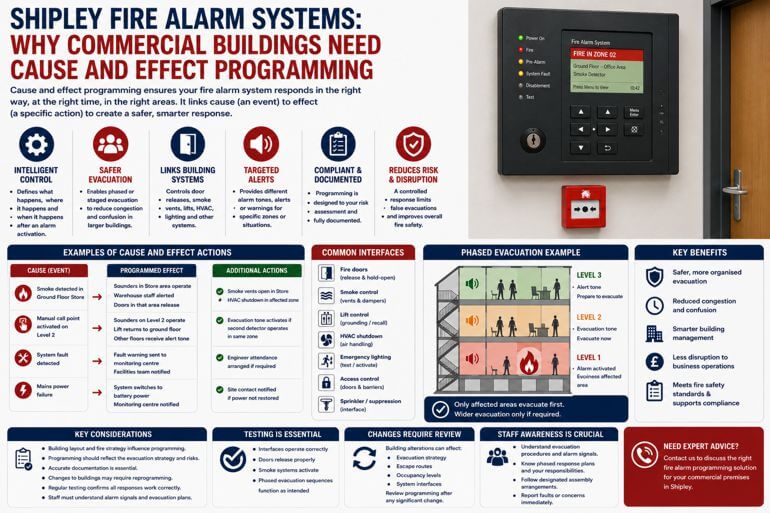
- phased evacuation
- staged alarm activation
- or selective area response
depending on the building’s design and risks.
Phased Evacuation Reduces Congestion
Simultaneous evacuation in large buildings can create:
- stairwell congestion
- confusion
- slower evacuation
- and increased risk
Cause and effect programming may allow:
- the affected zone to evacuate first
- neighbouring zones to receive alert warnings
- and wider evacuation only if escalation occurs
This creates a more organised response.
Fire Doors and Smoke Control Systems Can Be Linked
Modern commercial fire alarm systems frequently interact with other building systems.
Examples include:
- automatic door releases
- smoke vents
- air handling shutdowns
- lift grounding
- access control release
- and suppression systems
Cause and effect programming ensures these systems operate in the correct sequence during an emergency.
Different Alarm Devices Can Perform Different Roles
Not all sounders or indicators need to activate identically.
Systems may include:
- alert tones
- evacuation tones
- visual beacons
- voice evacuation systems
- or localised warnings
This is particularly useful in:
- healthcare settings
- educational buildings
- and high-occupancy premises
Poor Programming Can Create Confusion
Incorrect cause and effect configuration may result in:
- unnecessary full evacuations
- delayed responses
- conflicting system actions
- or occupant confusion
Programming should always reflect:
- the evacuation strategy
- fire risk assessment
- and operational requirements of the building
Building Layout Strongly Influences Programming
The way a system responds should reflect:
- compartmentation
- escape routes
- occupancy type
- floor arrangement
- and risk areas
For example:
- a warehouse may require different responses from an office block
- a hotel may require phased evacuation
- a school may prioritise specific zones
There is no universal programming template suitable for every premises.
Cause and Effect Must Be Properly Documented
Commercial systems should include accurate documentation showing:
- programmed responses
- linked interfaces
- device logic
- and evacuation sequences
This information is essential for:
- maintenance engineers
- responsible persons
- and emergency services
Changes to Buildings May Require Reprogramming
Building alterations can affect:
- evacuation strategy
- escape routes
- occupancy levels
- and system interfaces
Any significant layout or operational change should trigger a review of the fire alarm programming.
Testing Is Essential
Cause and effect programming should be tested regularly to confirm:
- interfaces operate correctly
- doors release properly
- smoke systems activate
- and phased evacuation sequences function as intended
Without testing, programming issues may remain hidden until an emergency occurs.
Staff Should Understand Evacuation Procedures
Different alarm stages or alert signals can confuse occupants if staff are not trained correctly.
Employees should understand:
- evacuation procedures
- alert signals
- phased response plans
- and assembly arrangements
Technology alone cannot replace effective staff awareness.
Intelligent Fire Alarm Response Improves Safety
For businesses in Shipley, cause and effect programming allows fire alarm systems to operate far more intelligently than simple “all alarms activate” configurations.
Correctly designed systems help provide:
- safer evacuation
- reduced disruption
- improved emergency coordination
- and better overall fire safety management
As commercial buildings become more complex, intelligent fire alarm programming is becoming an increasingly important part of effective system design.
Frequently Asked Questions
What is cause and effect in a fire alarm system?
It is the programmed logic that determines how the system reacts when alarms activate.
Why is phased evacuation used?
Phased evacuation helps reduce congestion and improves evacuation management in larger buildings.
Should fire alarm programming be reviewed after building changes?
- detectors
- call points
- sounders
- relays
- door releases
- smoke control systems
- and other connected equipment
In simple terms, it defines:
- what happens
- where it happens
- and when it happens
after an alarm activation occurs.
Not Every Building Should Evacuate Simultaneously
In smaller buildings, full evacuation is often straightforward.
However, larger commercial premises in Shipley such as:
- offices
- schools
- hotels
- industrial buildings
- healthcare premises
- and multi-storey properties
may require more controlled evacuation strategies.
Cause and effect programming allows:
- phased evacuation
- staged alarm activation
- or selective area response
depending on the building’s design and risks.
Phased Evacuation Reduces Congestion
Simultaneous evacuation in large buildings can create:
- stairwell congestion
- confusion
- slower evacuation
- and increased risk
Cause and effect programming may allow:
- the affected zone to evacuate first
- neighbouring zones to receive alert warnings
- and wider evacuation only if escalation occurs
This creates a more organised response.
Fire Doors and Smoke Control Systems Can Be Linked
Modern commercial fire alarm systems frequently interact with other building systems.
Examples include:
- automatic door releases
- smoke vents
- air handling shutdowns
- lift grounding
- access control release
- and suppression systems
Cause and effect programming ensures these systems operate in the correct sequence during an emergency.
Different Alarm Devices Can Perform Different Roles
Not all sounders or indicators need to activate identically.
Systems may include:
- alert tones
- evacuation tones
- visual beacons
- voice evacuation systems
- or localised warnings
This is particularly useful in:
- healthcare settings
- educational buildings
- and high-occupancy premises
Poor Programming Can Create Confusion
Incorrect cause and effect configuration may result in:
- unnecessary full evacuations
- delayed responses
- conflicting system actions
- or occupant confusion
Programming should always reflect:
- the evacuation strategy
- fire risk assessment
- and operational requirements of the building
Building Layout Strongly Influences Programming
The way a system responds should reflect:
- compartmentation
- escape routes
- occupancy type
- floor arrangement
- and risk areas
For example:
- a warehouse may require different responses from an office block
- a hotel may require phased evacuation
- a school may prioritise specific zones
There is no universal programming template suitable for every premises.
Cause and Effect Must Be Properly Documented
Commercial systems should include accurate documentation showing:
- programmed responses
- linked interfaces
- device logic
- and evacuation sequences
This information is essential for:
- maintenance engineers
- responsible persons
- and emergency services
Changes to Buildings May Require Reprogramming
Building alterations can affect:
- evacuation strategy
- escape routes
- occupancy levels
- and system interfaces
Any significant layout or operational change should trigger a review of the fire alarm programming.
Testing Is Essential
Cause and effect programming should be tested regularly to confirm:
- interfaces operate correctly
- doors release properly
- smoke systems activate
- and phased evacuation sequences function as intended
Without testing, programming issues may remain hidden until an emergency occurs.
Staff Should Understand Evacuation Procedures
Different alarm stages or alert signals can confuse occupants if staff are not trained correctly.
Employees should understand:
- evacuation procedures
- alert signals
- phased response plans
- and assembly arrangements
Technology alone cannot replace effective staff awareness.
Intelligent Fire Alarm Response Improves Safety
For businesses in Shipley, cause and effect programming allows fire alarm systems to operate far more intelligently than simple “all alarms activate” configurations.
Correctly designed systems help provide:
- safer evacuation
- reduced disruption
- improved emergency coordination
- and better overall fire safety management
As commercial buildings become more complex, intelligent fire alarm programming is becoming an increasingly important part of effective system design.
Frequently Asked Questions
What is cause and effect in a fire alarm system?
It is the programmed logic that determines how the system reacts when alarms activate.
Why is phased evacuation used?
Phased evacuation helps reduce congestion and improves evacuation management in larger buildings.
Should fire alarm programming be reviewed after building changes?
Yes. Layout, occupancy and operational changes may require updated programming and evacuation strategies.