Fire Alarm Downtime –
Most businesses understand that a commercial fire alarm system helps protect people and property, but fewer consider what happens if that system isn’t fully operational when an incident occurs.
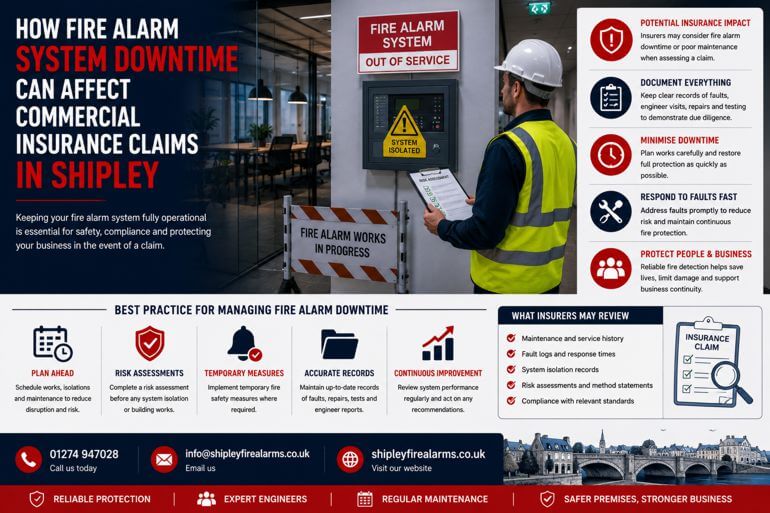
Whether a fire alarm has been isolated during refurbishment, left with unresolved faults or simply missed routine servicing, prolonged system downtime can create significant operational and financial consequences. It may also become a factor when insurers investigate a fire-related claim.
For businesses across Shipley, understanding the importance of maintaining continuous fire alarm protection helps reduce unnecessary risk and supports better business resilience.
What Is Fire Alarm Downtime?
Fire alarm downtime refers to any period where part or all of the fire detection system cannot provide its intended level of protection.
Examples include:
- Control panel faults.
- Disabled detection zones.
- Damaged detectors.
- Isolated sounder circuits.
- Planned refurbishment works.
- Communication faults.
- Power supply failures.
- Equipment awaiting replacement parts.
Some downtime is unavoidable during building works, but it should always be carefully managed.
Why It Matters
When a fire occurs, investigators often examine more than the cause of ignition.
They may review maintenance records, service reports, fault histories and whether life safety systems were operating correctly at the time of the incident.
Keeping accurate documentation demonstrates that fire safety has been managed responsibly and helps build a clear maintenance history.
Managing Planned Outages
There are occasions when parts of a fire alarm system must be temporarily isolated.
Examples include:
- Office refurbishments.
- Ceiling replacements.
- Detector relocation.
- Building extensions.
- Electrical upgrades.
Planning these works properly helps minimise the duration of reduced protection.
Temporary measures may also be introduced where appropriate until the permanent system is fully restored.
The Importance of Fault Response
Leaving faults unresolved for extended periods increases operational risk.
Modern addressable systems identify developing problems quickly, allowing engineers to investigate before faults affect wider areas of the building.
Responding promptly reduces downtime and helps maintain dependable protection.
Accurate Service Records
Routine maintenance creates a valuable record of the system’s condition.
Service reports document testing, repairs, recommendations and completed work, providing building owners with a clear history of ongoing maintenance.
These records also simplify future servicing and help identify recurring issues before they become expensive failures.
Business Continuity
Even a relatively small fire can interrupt trading for weeks.
Reliable fire detection, supported by regular maintenance and prompt fault resolution, helps reduce the likelihood of extended disruption whilst protecting employees, customers and valuable assets.
Planning for continuity means considering not only fire prevention but also how quickly a business could recover if an incident occurs.
Fire Alarm Support for Businesses in Shipley
Commercial fire alarm systems should never be viewed as fit-and-forget equipment.
Regular inspections, prompt repairs and careful management of any temporary downtime help ensure the system continues providing dependable protection throughout its working life.
Most businesses understand that a commercial fire alarm system helps protect people and property, but fewer consider what happens if that system isn’t fully operational when an incident occurs.
Whether a fire alarm has been isolated during refurbishment, left with unresolved faults or simply missed routine servicing, prolonged system downtime can create significant operational and financial consequences. It may also become a factor when insurers investigate a fire-related claim.
For businesses across Shipley, understanding the importance of maintaining continuous fire alarm protection helps reduce unnecessary risk and supports better business resilience.
What Is Fire Alarm Downtime?
Fire alarm downtime refers to any period where part or all of the fire detection system cannot provide its intended level of protection.
Examples include:
- Control panel faults.
- Disabled detection zones.
- Damaged detectors.
- Isolated sounder circuits.
- Planned refurbishment works.
- Communication faults.
- Power supply failures.
- Equipment awaiting replacement parts.
Some downtime is unavoidable during building works, but it should always be carefully managed.
Why It Matters
When a fire occurs, investigators often examine more than the cause of ignition.
They may review maintenance records, service reports, fault histories and whether life safety systems were operating correctly at the time of the incident.
Keeping accurate documentation demonstrates that fire safety has been managed responsibly and helps build a clear maintenance history.
Managing Planned Outages
There are occasions when parts of a fire alarm system must be temporarily isolated.
Examples include:
- Office refurbishments.
- Ceiling replacements.
- Detector relocation.
- Building extensions.
- Electrical upgrades.
Planning these works properly helps minimise the duration of reduced protection.
Temporary measures may also be introduced where appropriate until the permanent system is fully restored.
The Importance of Fault Response
Leaving faults unresolved for extended periods increases operational risk.
Modern addressable systems identify developing problems quickly, allowing engineers to investigate before faults affect wider areas of the building.
Responding promptly reduces downtime and helps maintain dependable protection.
Accurate Service Records
Routine maintenance creates a valuable record of the system’s condition.
Service reports document testing, repairs, recommendations and completed work, providing building owners with a clear history of ongoing maintenance.
These records also simplify future servicing and help identify recurring issues before they become expensive failures.
Business Continuity
Even a relatively small fire can interrupt trading for weeks.
Reliable fire detection, supported by regular maintenance and prompt fault resolution, helps reduce the likelihood of extended disruption whilst protecting employees, customers and valuable assets.
Planning for continuity means considering not only fire prevention but also how quickly a business could recover if an incident occurs.
Fire Alarm Support for Businesses in Shipley
Commercial fire alarm systems should never be viewed as fit-and-forget equipment.
Regular inspections, prompt repairs and careful management of any temporary downtime help ensure the system continues providing dependable protection throughout its working life.
For businesses throughout Shipley, taking a proactive approach to fire alarm maintenance supports safer premises, better operational resilience and confidence that life safety systems are available whenever they are needed.