Cause & Effect Delays –
Modern commercial fire alarm systems are designed to do far more than simply sound bells throughout a building. Many systems across Shipley now control:
- evacuation sequencing
- smoke ventilation
- automatic doors
- lift grounding
- suppression systems
- and wider building safety functions
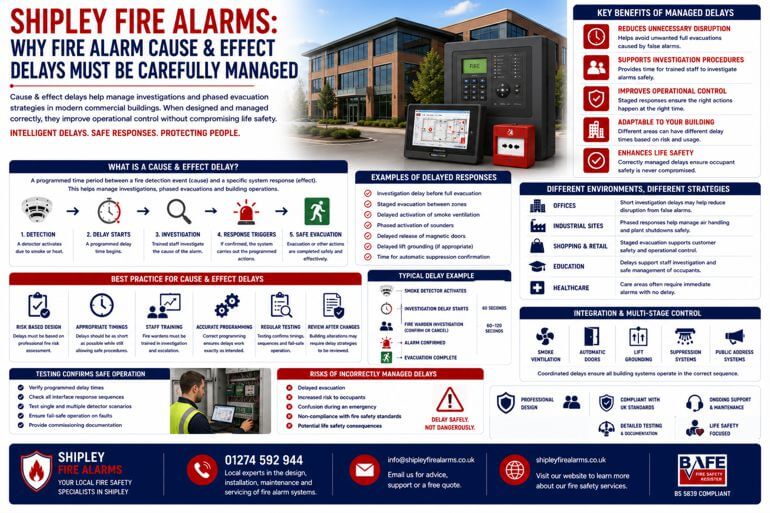
Within these advanced systems, cause and effect delays are sometimes used to help manage investigations, phased evacuation or operational response procedures. However, these delays must be designed and managed extremely carefully to ensure life safety always remains the priority.
What Is A Cause & Effect Delay?
A cause and effect delay is a programmed period between:
- a detector activation
- and a specific system response
For example:
- a detector may trigger a short investigation delay before full evacuation begins
- or certain interfaces may activate in a staged sequence
depending on the building’s evacuation strategy and operational requirements.
Delays Are Common In Larger Commercial Buildings
Commercial environments such as:
- office complexes
- shopping environments
- industrial premises
- and multi-zone buildings
may use delays to help reduce:
- unnecessary disruption
- operational downtime
- or unwanted full evacuations
where appropriate and compliant.
Life Safety Must Always Come First
Although delays can improve operational flexibility, they should never compromise:
- occupant safety
- evacuation speed
- or emergency response effectiveness
High-risk areas typically still require:
- immediate alarm activation
- rapid evacuation
- and instant interface response
without delay.
Different Areas May Require Different Response Times
Modern buildings often contain:
- public access areas
- plant rooms
- kitchens
- offices
- and restricted operational zones
Each environment may require different:
- evacuation priorities
- investigation procedures
- and alarm response timings
depending on risk assessment findings.
Delays Must Be Carefully Programmed
Incorrectly configured delays may create:
- confusion
- delayed evacuation
- or operational risk
Professional cause and effect programming helps ensure:
- delays remain appropriate
- timing sequences operate correctly
- and evacuation strategies remain compliant
Staff Training Becomes Increasingly Important
Where investigation delays are used, staff may require:
- fire warden procedures
- alarm investigation training
- and clear escalation processes
to ensure delays are managed safely and effectively.
Multi-Stage Alarm Strategies Are Becoming More Common
Larger buildings increasingly use:
- phased evacuation
- staged alarms
- investigation periods
- and selective evacuation strategies
rather than immediate full-building evacuation for every activation.
These approaches require:
- intelligent programming
- careful testing
- and robust operational procedures
Testing Confirms Delays Operate Correctly
Cause and effect testing helps verify:
- programmed timings
- interface sequencing
- evacuation operation
- and fail-safe responses
under real operating conditions.
Without proper testing, systems may not behave exactly as intended during emergencies.
Building Changes May Affect Delay Strategies
Commercial buildings frequently evolve through:
- refurbishments
- occupancy changes
- office reconfiguration
- and operational expansion
These changes may affect:
- evacuation routes
- risk profiles
- and delay suitability
which is why periodic review remains important.
Modern Fire Alarm Systems Require Intelligent Management
For businesses in Shipley, modern fire alarm systems increasingly rely on advanced programming and carefully managed operational logic.
Professional cause and effect delay management helps provide:
- safer evacuation strategies
- reduced unnecessary disruption
- improved operational control
- and stronger life safety performance
As commercial buildings become more complex, intelligent fire alarm sequencing is becoming an increasingly important part of modern fire safety system design.
Frequently Asked Questions
What is a fire alarm delay?
It is a programmed time period between a fire alarm activation and a specific system response.
Why are delays used in commercial fire alarm systems?
They may support investigation procedures or phased evacuation strategies in suitable environments.
Are delays suitable for all buildings?
Modern commercial fire alarm systems are designed to do far more than simply sound bells throughout a building. Many systems across Shipley now control:
- evacuation sequencing
- smoke ventilation
- automatic doors
- lift grounding
- suppression systems
- and wider building safety functions
Within these advanced systems, cause and effect delays are sometimes used to help manage investigations, phased evacuation or operational response procedures. However, these delays must be designed and managed extremely carefully to ensure life safety always remains the priority.
What Is A Cause & Effect Delay?
A cause and effect delay is a programmed period between:
- a detector activation
- and a specific system response
For example:
- a detector may trigger a short investigation delay before full evacuation begins
- or certain interfaces may activate in a staged sequence
depending on the building’s evacuation strategy and operational requirements.
Delays Are Common In Larger Commercial Buildings
Commercial environments such as:
- office complexes
- shopping environments
- industrial premises
- and multi-zone buildings
may use delays to help reduce:
- unnecessary disruption
- operational downtime
- or unwanted full evacuations
where appropriate and compliant.
Life Safety Must Always Come First
Although delays can improve operational flexibility, they should never compromise:
- occupant safety
- evacuation speed
- or emergency response effectiveness
High-risk areas typically still require:
- immediate alarm activation
- rapid evacuation
- and instant interface response
without delay.
Different Areas May Require Different Response Times
Modern buildings often contain:
- public access areas
- plant rooms
- kitchens
- offices
- and restricted operational zones
Each environment may require different:
- evacuation priorities
- investigation procedures
- and alarm response timings
depending on risk assessment findings.
Delays Must Be Carefully Programmed
Incorrectly configured delays may create:
- confusion
- delayed evacuation
- or operational risk
Professional cause and effect programming helps ensure:
- delays remain appropriate
- timing sequences operate correctly
- and evacuation strategies remain compliant
Staff Training Becomes Increasingly Important
Where investigation delays are used, staff may require:
- fire warden procedures
- alarm investigation training
- and clear escalation processes
to ensure delays are managed safely and effectively.
Multi-Stage Alarm Strategies Are Becoming More Common
Larger buildings increasingly use:
- phased evacuation
- staged alarms
- investigation periods
- and selective evacuation strategies
rather than immediate full-building evacuation for every activation.
These approaches require:
- intelligent programming
- careful testing
- and robust operational procedures
Testing Confirms Delays Operate Correctly
Cause and effect testing helps verify:
- programmed timings
- interface sequencing
- evacuation operation
- and fail-safe responses
under real operating conditions.
Without proper testing, systems may not behave exactly as intended during emergencies.
Building Changes May Affect Delay Strategies
Commercial buildings frequently evolve through:
- refurbishments
- occupancy changes
- office reconfiguration
- and operational expansion
These changes may affect:
- evacuation routes
- risk profiles
- and delay suitability
which is why periodic review remains important.
Modern Fire Alarm Systems Require Intelligent Management
For businesses in Shipley, modern fire alarm systems increasingly rely on advanced programming and carefully managed operational logic.
Professional cause and effect delay management helps provide:
- safer evacuation strategies
- reduced unnecessary disruption
- improved operational control
- and stronger life safety performance
As commercial buildings become more complex, intelligent fire alarm sequencing is becoming an increasingly important part of modern fire safety system design.
Frequently Asked Questions
What is a fire alarm delay?
It is a programmed time period between a fire alarm activation and a specific system response.
Why are delays used in commercial fire alarm systems?
They may support investigation procedures or phased evacuation strategies in suitable environments.
Are delays suitable for all buildings?
No. Delay strategies must always be based on professional fire risk assessment and system design.